Excavation depth and base thickness written into every quote
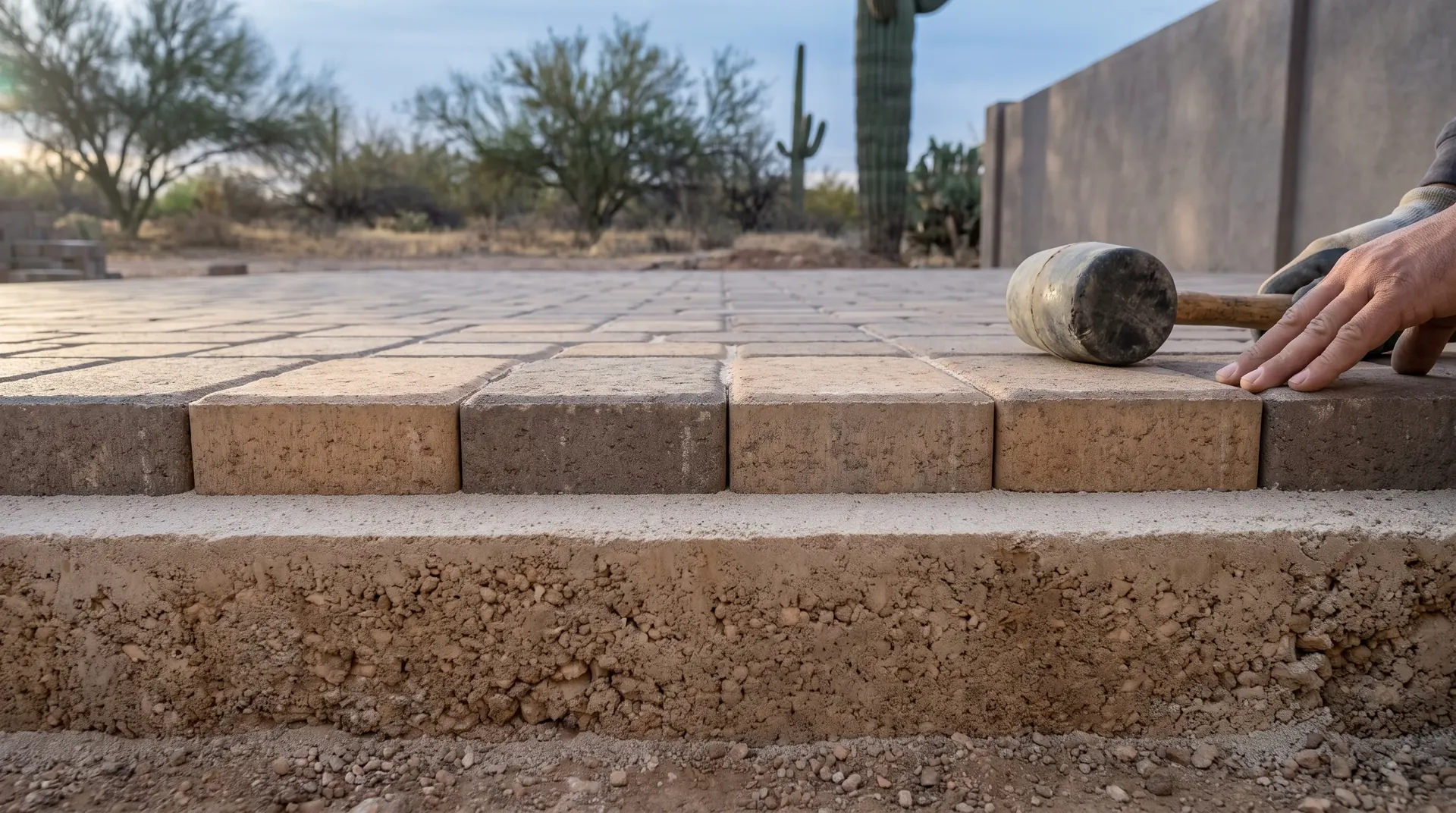
Compacted in lifts, not once at the end
Edge restraint on every open edge
Pavers only, so we do one thing properly
Three layers, three completely different jobs. Compacted aggregate base carries the load. A thin screeded bedding layer sets the final level. Joint sand locks the units together so the surface behaves as one thing rather than as hundreds of separate blocks.
Almost every paver failure anybody ever describes to us traces back to one of those three being wrong. Getting them confused with each other is the single most common mistake, and it is the reason so many patios in this city are flat for two years and then not.
The base carries everything
Under the whole assembly is compacted aggregate, and this is the structural layer. It spreads the load from the surface out over a wide area of subgrade, so that a table leg or a car tyre is not pressing directly into desert soil.
Two things make it work, and both get skipped.
Depth. How deep depends on what the surface has to carry and on what is underneath it. A patio needs less than a driveway. Soft or variable ground needs more than firm ground. This is why a real quote states a depth and why a site visit exists: nobody can specify it from a photograph.
Compaction in lifts. This is the one nobody sees and almost nobody asks about. Base material has to go in in layers, with a compactor pass on each layer, because a plate compactor only densifies material to a limited depth below it. Dump the whole depth in at once and compact the top, and you have a dense crust over loose material. It looks identical. It consolidates slowly under use over the next two or three years, which is exactly the timescale on which patios develop dips.
Ask any contractor how thick the base will be and whether it is compacted in lifts. The answer tells you a great deal.
Thin, consistent, and not a leveller
On top of the compacted base goes a thin screeded layer of bedding material. Its only job is to give the pavers a consistent surface to sit on, so each unit ends up at the right level without rocking.
The critical thing about it is that it is thin and it is uniform. That is not an aesthetic preference, it is structural. Loose bedding material consolidates under load, and the more of it there is, the more it consolidates and the more unevenly it does so. A generous bed of sand feels forgiving to work with and produces a surface that goes wavy.
Which brings us to the mistake that causes more settled patios than anything else: using bedding sand to correct an uneven base. If the base is out, the fix is to correct the base. Screeding extra sand into the low spots buries the problem under something that will not stay put.
If you are getting quotes and someone proposes a deep sand layer instead of a proper compacted base, that is the moment to stop.
The joints are what make it a pavement
An interlocking pavement is not units sitting side by side. It is a system, and joint sand is the mechanism.
When a load lands on one paver, sand in the joints transfers part of that load sideways into the neighbouring units, which pass it on further. The load spreads across many pavers instead of being carried by one. That is what lets a flexible pavement handle vehicles, and what lets it flex slightly with ground movement instead of cracking.
Remove the sand and the mechanism stops. Each unit carries its own load, so it rocks. Edges knock together and chip. Water goes straight into the bedding layer and starts moving it. The field slowly spreads outward. All of it progressive, none of it dramatic enough to notice early.
Joints lose sand for ordinary reasons, including settling in over the first season, wind, monsoon runoff and pressure washing. Topping them up is the cheapest maintenance available on a paver surface and the most valuable thing you can do to protect the base.
The layer that is not a layer
Everything above assumes the field stays where it was put, and the only thing making that true is restraint along every open edge.
A paver field is under constant outward pressure from traffic and from thermal movement. With nothing holding the perimeter, the outer courses migrate outward a fraction at a time. Joints near the edge open, sand escapes through the widened joints, and the field loses its interlock from the outside in.
On a patio one or two sides are usually held by a wall or a slab. On a path both edges are open, which is why restraint costs proportionally more on narrow work and why it is the first thing removed from a cheap quote.
Caliche, and what it does to all of this
Under a lot of lots here sits caliche, a cemented layer that can be inches or feet down and varies across a single property.
Where it is solid and shallow it is genuinely good news: an excellent bearing surface that means less excavation. Where it is a broken layer over softer soil it is the opposite, because it stops water moving downward and holds it against the underside of your base. Wet base material does not behave like dry base material.
Neither situation is visible from the surface, which is why probing before quoting a depth matters here more than it does in most markets, and why two identical patios three streets apart can honestly cost different amounts.
What to ask, whoever you hire
Excavation depth, and where the spoil goes. Compacted base thickness, and whether it goes in in lifts. The bedding layer thickness. Edge restraint on every open edge. Joint sand type and whether final compaction is included.
Five questions. Any contractor who builds properly will answer all five without hesitating, and the answers make two quotes comparable that otherwise are not.
From a People Also Ask harvest
Questions people actually ask
What happens if I don't put gravel under pavers?
The pavers bear directly on soil that compacts unevenly under load and washes out at the edges during monsoon runoff. Low spots appear first, then joints open, then the field starts moving. It is the cheapest possible installation and by a distance the most expensive to put right, because correcting it means lifting everything and starting again from the subgrade.
What are the steps for a beginner to lay pavers?
Mark the area and establish the fall before anything else. Excavate to depth, allowing for base plus bedding plus paver thickness. Compact the subgrade. Place base in layers, compacting each one. Screed a thin consistent bedding layer. Lay to a string line, working from a straight edge. Cut the borders on a saw. Fit edge restraint. Sweep in joint sand, compact with a protective pad, then top the joints up again. The steps people skip are compacting in lifts and the edge restraint.
Do you tamp down sand before laying pavers?
The bedding layer is screeded, not compacted, and that trips a lot of people up. It is left loose and uniform so the pavers can be set into it and levelled, then the whole field is compacted at the end, which beds the pavers and settles the joint sand in one operation. What definitely does get compacted, thoroughly and in lifts, is the aggregate base beneath it.
What is the best product to level ground for pavers?
For the structural layer, a well graded crushed aggregate that locks together when compacted. For the thin bedding layer above it, a clean coarse sand or a fine chip suited to bedding. What is not a levelling product is loose sand poured in to fill hollows, and no product substitutes for excavating and compacting properly in the first place. ---
Free on site quote
Want to know what is under yours?
If your patio has started to dip, the answer is under it. Send us a photo and tell us roughly how old it is. We will come out and find out.
Or call (520) 555-0194. Mon to Fri, 7am to 5pm. Saturday by appointment.
That is with us
We will call to arrange the site visit, usually the same working day. If it is urgent, call(520) 555-0194.