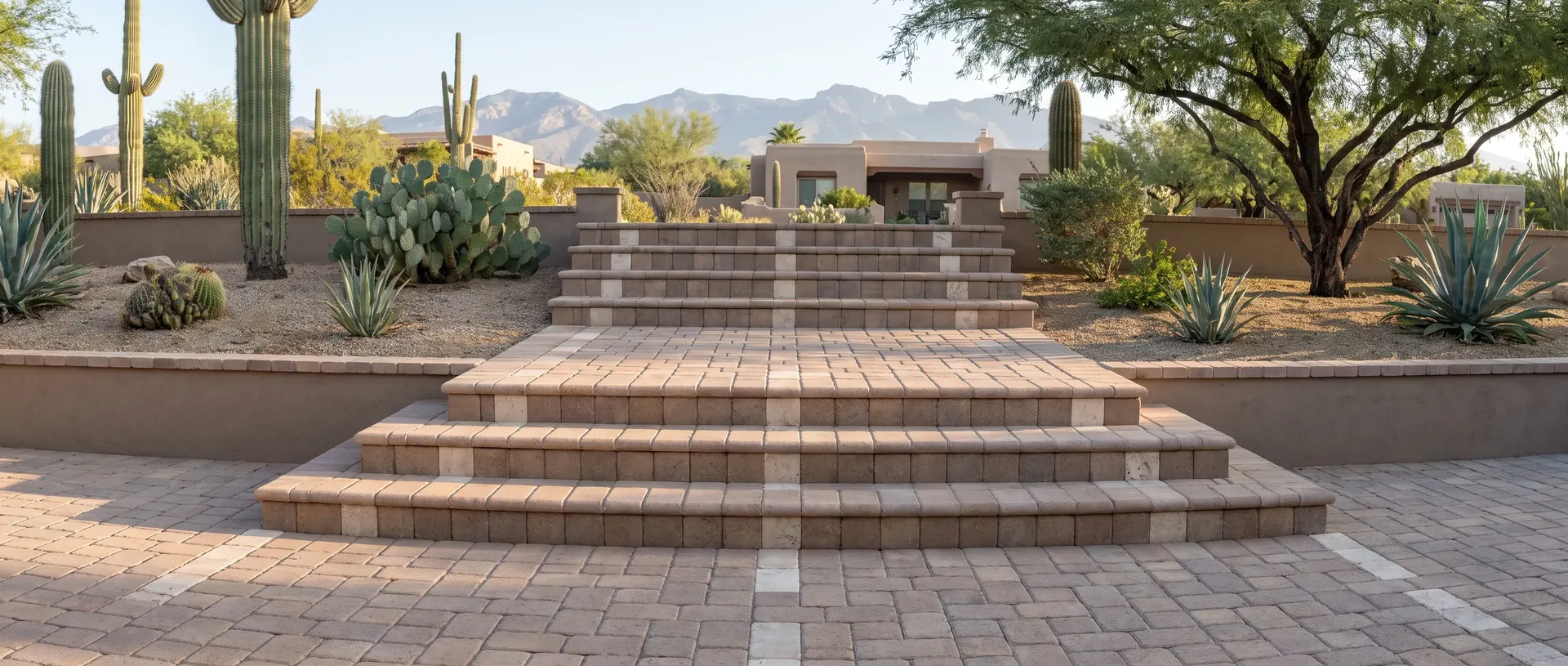
Consistent rise and going, checked across every step
Installation
Paver Steps and Entries in Tucson
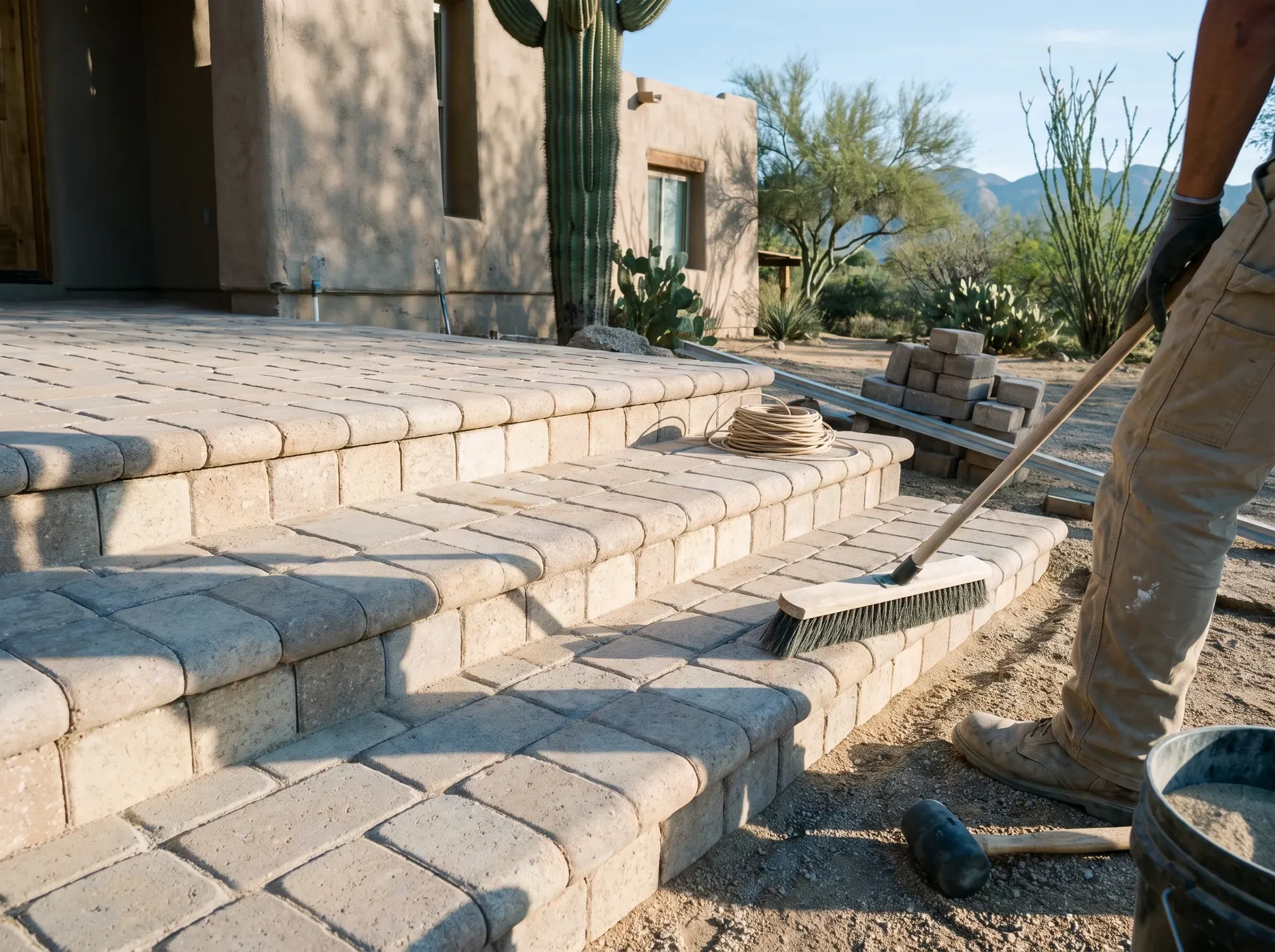
Built on footings, not stacked on fill. The foot notices a quarter inch of variation, and it notices it by tripping.
Footings under every riser
Treads laid with fall so water leaves them
Nosings detailed so the edge does not chip
Before you choose anything
This is the one with a safety consequence
Everything else we build is about whether a surface still looks right in ten years. Steps are different. Steps are the part of a paver project where getting it wrong hurts somebody.
The human foot is extraordinarily good at climbing a flight without looking, and it does that by learning the rise on the first step and assuming every step after it is identical. When one riser is half an inch taller than the rest, the foot arrives lower than the brain expected and the person stumbles. It is why people say a particular set of steps is awkward without being able to explain why.
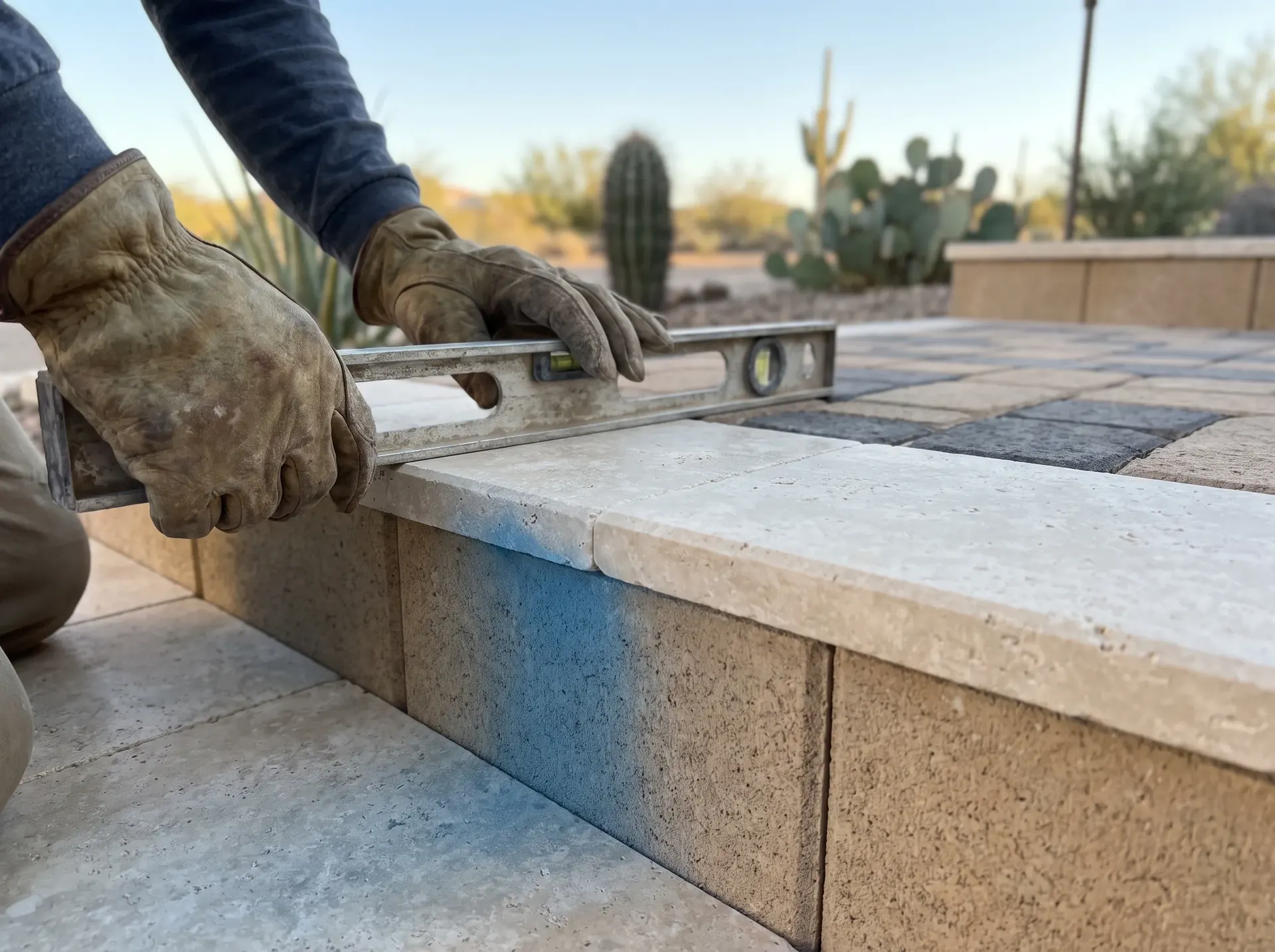
So consistent rise and consistent going across every step in a flight is not a nicety, it is the specification. We check it with a level across each step as it is built rather than measuring the first one and trusting the rest.
The second thing that separates real steps from stacked pavers is what is underneath. Risers built on compacted fill move over time, and when they move the rise changes. Steps get footings. It is slower and it costs more and it is the detail we are least willing to negotiate.
The work itself
What we build
Front entry steps and landings
The two or three steps from a path up to a front door, with a landing at the top big enough to stand on with the screen door open. Small in area and disproportionately visible.
Terrace and grade change steps
Flights linking levels in a sloping yard, common on Foothills and Dove Mountain lots. Often combined with a low wall on one side, and the point where the levels of the whole yard get resolved.
Pool and spa entry steps
Steps up to a raised spa or down to a sunken deck area, where the surface is walked on wet and barefoot and the nosing detail and slip behaviour matter more than anywhere else.
Line by line
What is included
Setting out and rise calculation
Total height measured properly and divided into equal risers before anything is dug, so the flight arrives at the landing at the right height instead of finishing with one odd step.
Excavation and footings
Trenches excavated below grade and footings poured for the risers, so the structure is bearing on something rather than sitting on backfill that will consolidate.
Risers, treads and nosings
Risers built to the calculated height, treads laid with a slight fall so water runs off rather than sitting, and the nosing detailed with a full unit or a bullnose rather than a thin cut that will chip.
Tie in, joints and finish
The flight tied into the path or patio at each end with the levels resolved, joints sanded and settled, and the surrounding surface reinstated.
Six steps, in this order
How the build runs
1Site visit and measure
We measure the total height accurately, look at where the flight has to land at both ends, and check what the ground is doing on the slope.
2Rise, going and layout
The number of steps and the exact rise calculated, the tread depth agreed, and the width set. If the total height divides awkwardly we will tell you what the options are rather than absorbing the difference into one step.
3Fixed quote
Itemised by step and by landing, with footings shown separately from the paving.
4Utilities and access
Blue stake locates before we dig. On sloping lots we also work out how material gets up or down to the work area.
5Build
Excavate, pour footings, cure, build risers, lay treads, tie in at both ends, sand and compact.
6Walk the flight
We walk up and down it with you before we call it finished. If a step feels wrong, it is wrong, and that is the moment to find out.
Why us
Why build with us
We put footings under risers. Stacked pavers on compacted fill are quicker and cheaper and they move, and when steps move the rise changes and the flight becomes a hazard. This is the one item on our quotes we will not value engineer.
We check every step rather than the first one. It takes a few extra minutes per step and it is the entire difference between a flight people use without thinking and a flight people learn to be careful on.
And we detail the nosing properly. A thin sliver of cut paver at the front edge of a tread is the piece that takes every impact, every dragged chair leg and every dropped tool, and it is the piece that chips first. Using a full unit or a proper bullnose there costs a little more and lasts.
Want a real number on your steps?
Send us a photo of the slope and roughly how much height you need to climb. We will come out and measure it properly.
From a People Also Ask harvest
Paver step questions
Can pavers be used as steps?
Yes, and they are a good material for it, provided the flight is built as a structure rather than assembled as a stack. That means footings under the risers, purpose made step or wall units rather than thin paving units carrying the riser load, and a properly detailed nosing. Pavers laid dry on compacted fill will look correct and will not stay correct.
How much do paver steps cost?
Steps are priced per step and per landing rather than by area, because the footing, the riser and the tie in at each end are the work. A short flight in an easy position and a long flight up a rocky slope with restricted access are very different numbers for the same height climbed.
How can I make steps from pavers?
The honest short answer is that this is the one paver job we would steer a capable homeowner away from, because the failure mode is somebody falling. If you are going to do it anyway, the parts that matter are: measure the total height and divide it into equal risers before you dig, pour footings, use units rated to carry the riser load rather than thin paving, and check the rise on every single step with a level rather than trusting the first one.
What are the best pavers for steps?
Purpose made step units or wall block for the risers, with a full paver or a bullnose unit for the tread and nosing. The nosing is where the material choice really matters, because it takes all the impact and all the wear. Around a pool or anywhere the flight gets walked on wet, pick a unit with genuine surface texture rather than a smooth face.
Pima County
Where we build
We build across Tucson, Oro Valley, Marana, Vail, Sahuarita, Green Valley, Catalina Foothills, Casas Adobes, Rita Ranch, Dove Mountain, Corona de Tucson and Tanque Verde.
Next door to this one
Related paver work
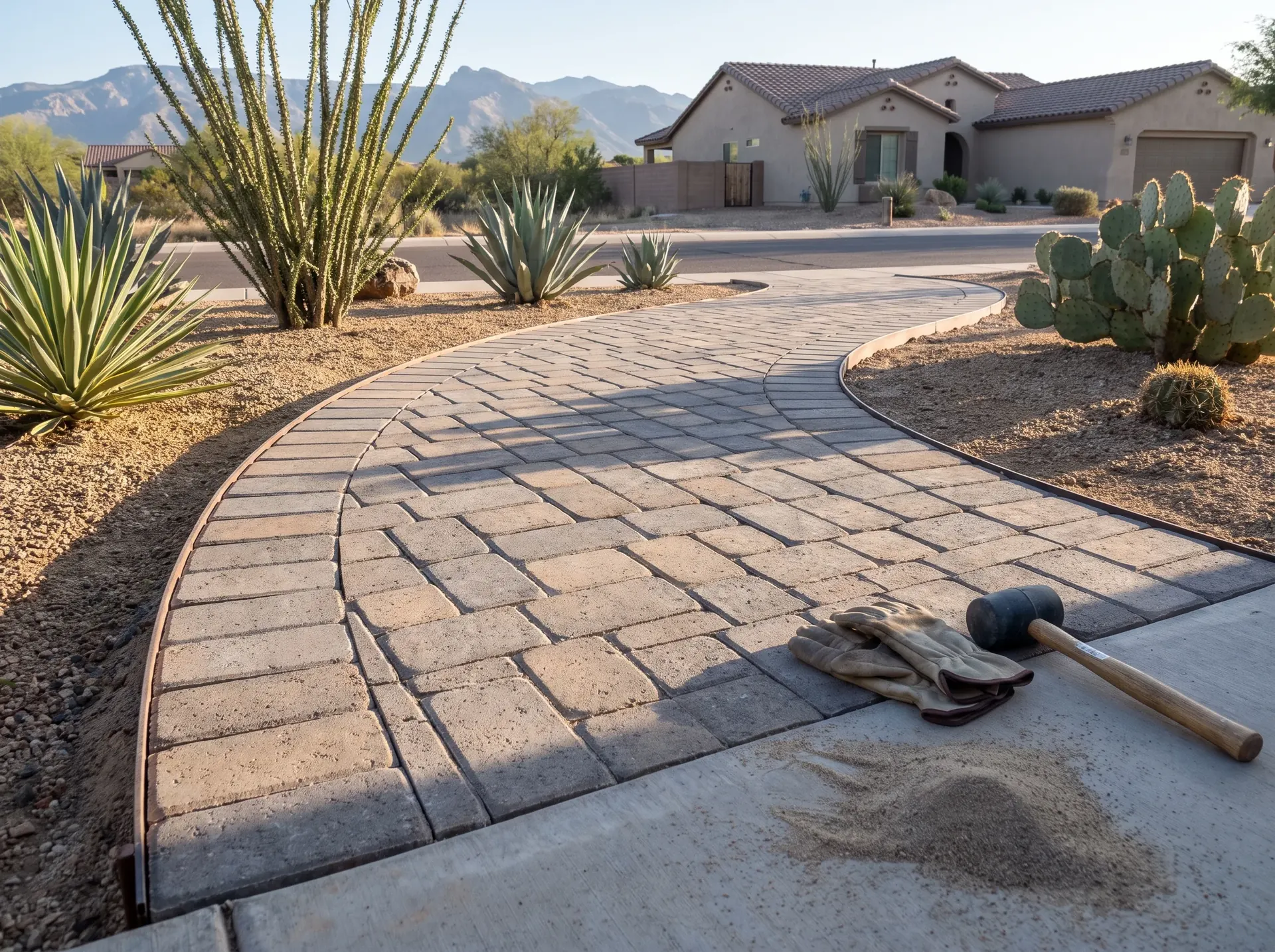 Paver Walkways and PathsNarrow surfaces have nowhere to hide. Both edges restrained, curves set to a radius rather than eyeballed, and cuts made on a saw so the border reads clean from the sidewalk.See the detail
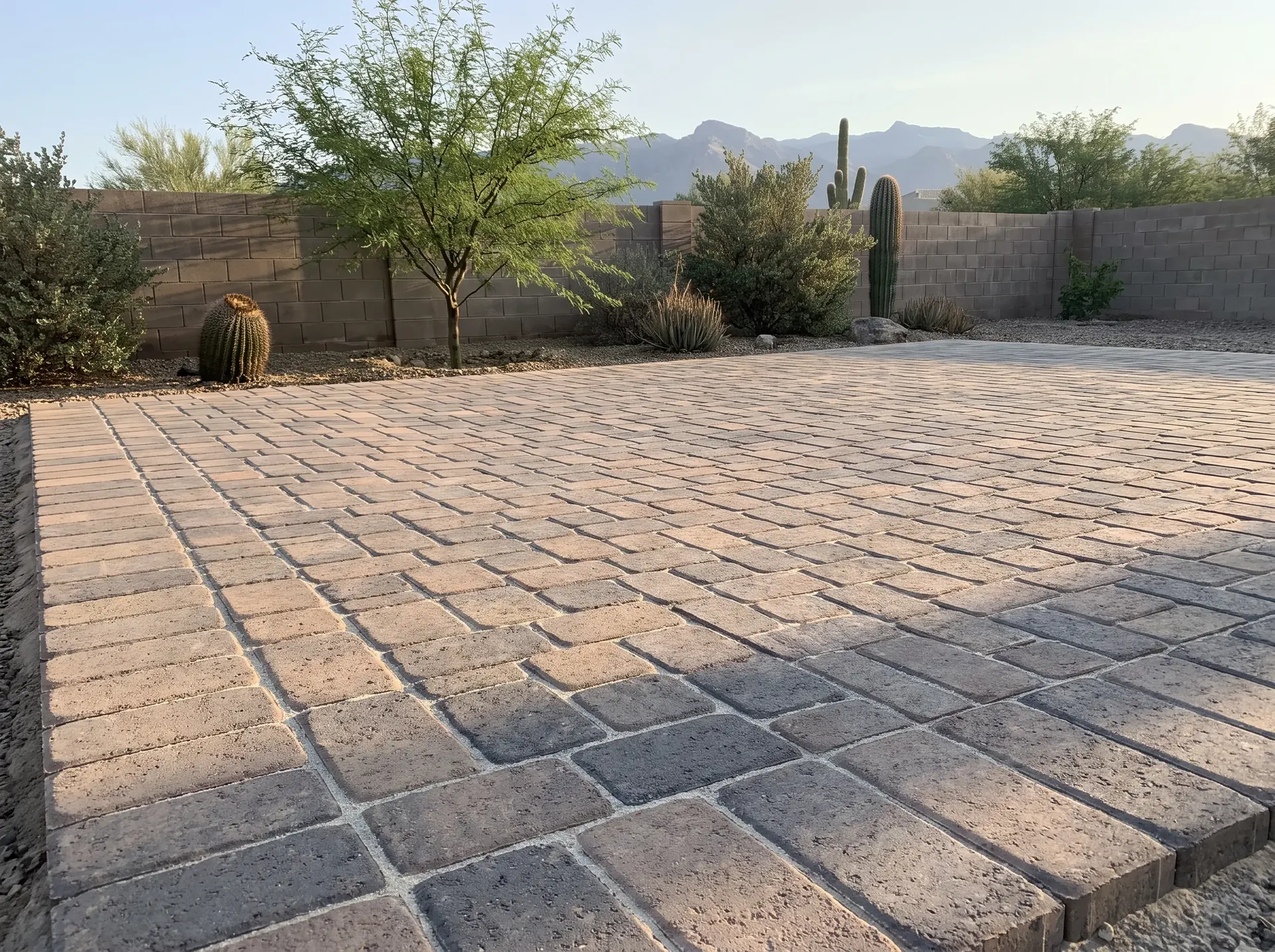 Paver PatiosThe main entertaining surface, sized around what actually goes on it and laid with the fall running away from the house. Excavation and base depth quoted in writing, edge restraint on every open edge.See the detail
 Paver Seat Walls and PlantersOne of the five services we offer that does not have a page of its own yet. It is on the services hub, and we are happy to quote it.On the services hub
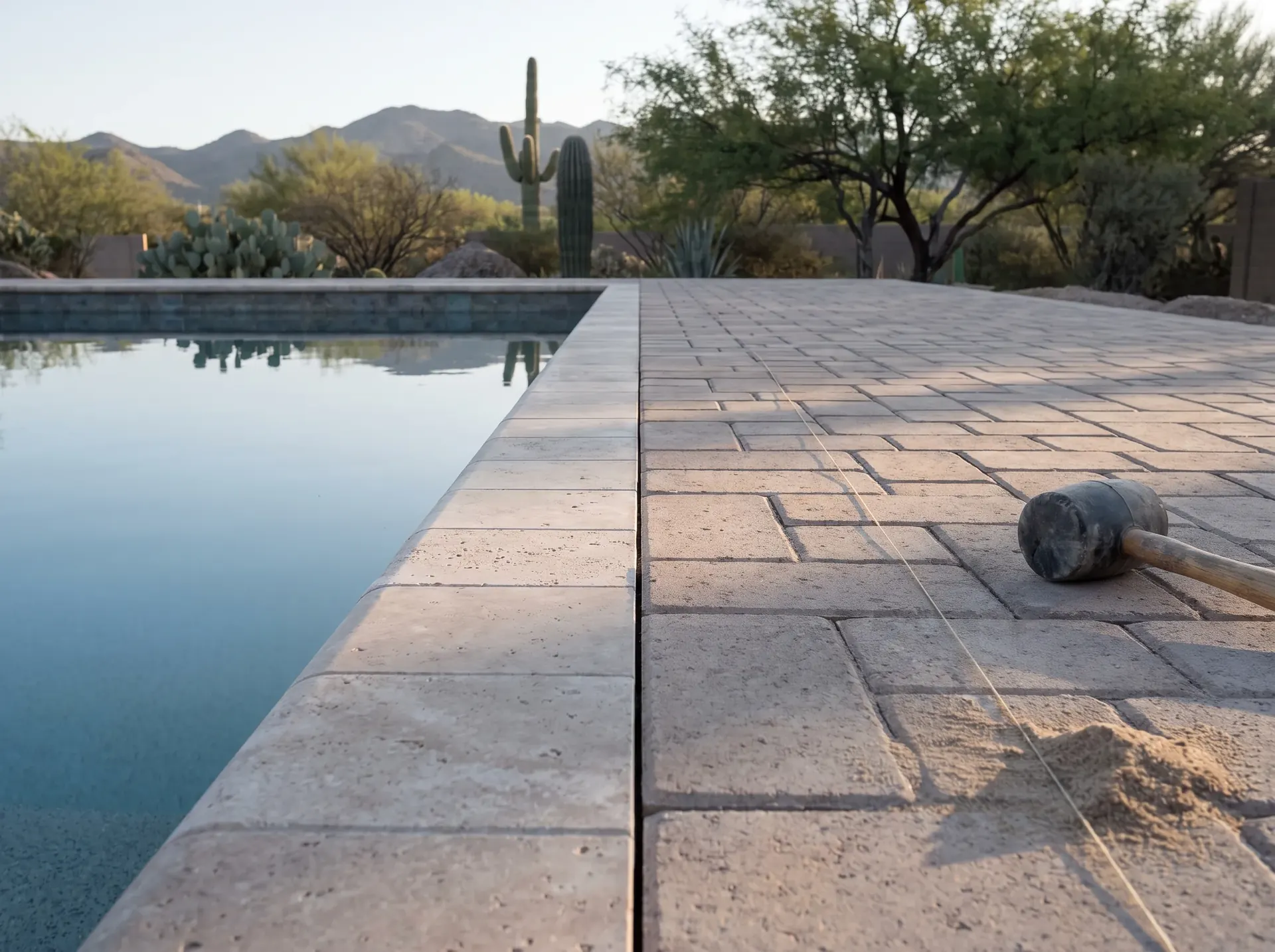 Pool Deck Pavers and CopingCoping set first and the deck built to it, fall running away from the water rather than into it, and light materials chosen because people cross this surface barefoot and wet.See the detail
Free on site quote
Get a quote for your steps
Tell us roughly how much height the flight has to climb and send a photo of the slope. We will come out and measure it.
Or call (520) 555-0194. Mon to Fri, 7am to 5pm. Saturday by appointment.
That is with us
We will call to arrange the site visit, usually the same working day. If it is urgent, call(520) 555-0194.